
Conflict-Informed >Trauma-Informed: The Shift the Divorce Coaching Field Needs Now
The alternative dispute resolution space has adopted a single dominant framework for working with divorcing and co-parenting clients: trauma-informed care. It's become the credential everyone lists, the training everyone takes, and the language everyone speaks.
But at Divorce Coaches Academy®, we've been asking a different question, one that the field hasn't been willing to sit with: Is trauma-informed care actually the right primary framework for ADR professionals working in divorce and co-parenting?
Our answer is no. Not because it doesn't matter. But because it's incomplete and treating it as the whole picture is costing clients the support they actually need.
What Is Trauma-Informed Care?
Before we challenge the framework, it's important to define it on its own terms.
Trauma-informed care is a widely recognized approach that originated in behavioral health and clinical settings. It is built on several key principles: recognizing the widespread impact of trauma, understanding the potential paths for recovery, anticipating and responding to the effects of all types of trauma, emphasizing physical and psychological safety, and creating supportive, trustworthy environments that avoid re-traumatization.
This is important work. In clinical settings like therapy offices, crisis intervention, and inpatient treatment, these principles save lives. They create the conditions for healing. The professionals trained to deliver trauma-informed care within those settings are doing essential, skilled work that requires years of specialized education and clinical supervision.
The question isn't whether trauma-informed care has value. It does. The question is whether it belongs at the center of a dispute resolution practice, or whether it's been misapplied as the primary framework in a space where the presenting problem isn't trauma. It's conflict.
Why Trauma-Informed Care Alone Falls Short in Divorce Coaching
When the divorce coaching and co-parenting support space adopted trauma-informed language, it did so with good intentions. Divorce is painful. Clients are hurting. It makes sense to want to approach that pain with care.
But somewhere along the way, the field confused the conditions for healing with the skills for conflict resolution. That confusion has created two significant problems for divorce coaches and the clients they serve.
It blurs the professional boundary between coaching and therapy. Trauma-informed care was designed for clinical environments. When divorce coaches and ADR professionals adopt it as their primary lens, they risk drifting into therapeutic territory, processing pain, exploring wounds, centering emotional recovery, without the clinical training, licensing, or ethical framework that work requires. That doesn't just put the professional at risk. It puts the client at risk.
It misses what's actually happening in the room. When a divorce coach sits across from a client, the presenting dynamic is conflict, not trauma. It's an individual who is engaged in a high-stakes dispute with their spouse over property, custody, finances, and the future of their family. It's escalation patterns, reactive decision-making, and communication breakdowns that are actively eroding outcomes. Trauma may be underneath some of that behavior. But the conflict is what's driving the decisions, and the conflict is what the ADR professional is there to address.
Creating a safe, trustworthy environment, which trauma-informed care does well, doesn't teach a client how to engage with conflict differently. A client can sit in the most psychologically safe space a professional can build and still walk into mediation reactive, escalating, and making choices that work against their own interests and their children's wellbeing.
What Is Conflict-Informed Divorce Coaching?
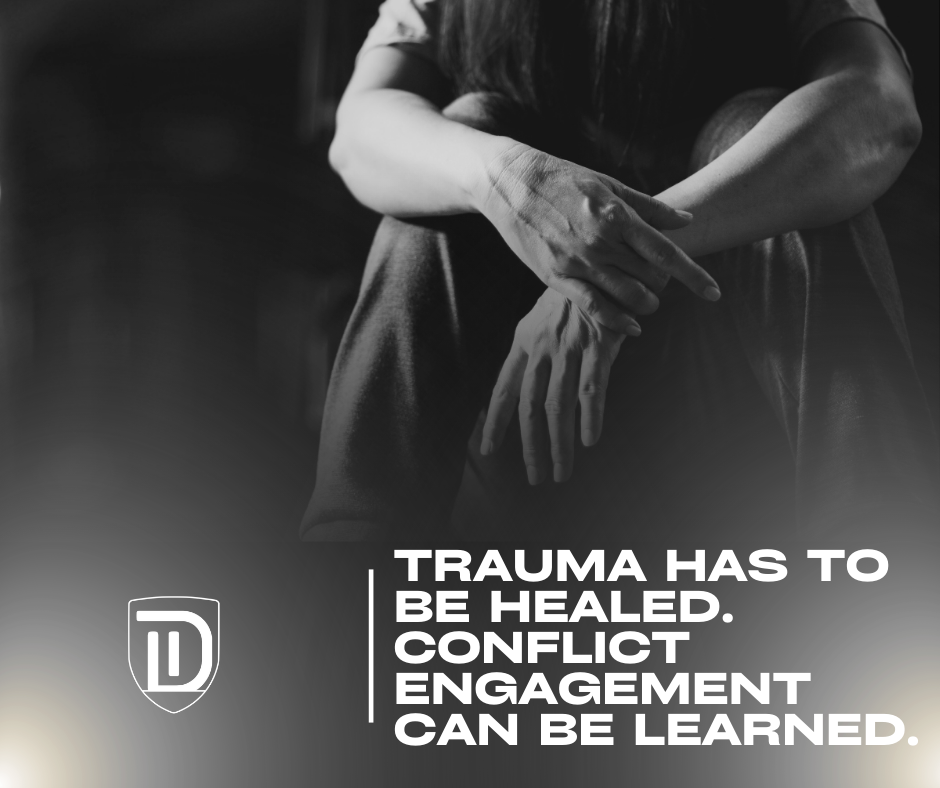
Here's the distinction that matters most: trauma has to be healed. Conflict engagement can be learned.
Healing trauma is the work of therapists and clinicians. It requires specialized training, ethical boundaries, and often years of therapeutic intervention. Divorce coaches are not therapists. We shouldn't try to be.
But conflict engagement skills — how to de-escalate, how to communicate under pressure, how to separate emotional reactivity from practical decision-making, how to participate constructively in mediation and co-parenting — these are teachable. They can be learned, practiced, and applied, often within the span of a coaching relationship.
A conflict-informed divorce coach understands the architecture of conflict itself — how it escalates, how it sustains itself, how it pulls people into patterns that feel impossible to break. More importantly, they know how to intervene at the level of the conflict rather than the level of the wound.
In practice, conflict-informed divorce coaching looks fundamentally different from a trauma-informed approach: A trauma-informed approach asks: "What wound is being activated?" A conflict-informed approach asks: "What pattern is driving this, and how do we interrupt it?" Both questions are valid. But only one falls within the scope of a divorce coach's practice.
A trauma-informed approach centers creating safety and avoiding re-traumatization. A conflict-informed approach centers building engagement skills the client can use immediately, in their next mediation session, their next co-parenting exchange, their next difficult conversation.
A trauma-informed approach works at the level of recovery. A conflict-informed approach works at the level of the dispute — helping clients navigate one of the most consequential negotiations of their lives without escalating the very conflict they're trying to resolve.
Why the Divorce Field Defaults to Trauma-Informed Language
It's worth understanding how we got here. Trauma-informed care has become ubiquitous across the broader wellness and coaching industries. The language feels compassionate. The training is widely available. And in a field like divorce coaching, where practitioners genuinely care about people in pain, it's natural to gravitate toward a framework that says "let's be gentle with hurting people."
But the ADR space isn't the wellness space. Divorce coaches work within and alongside a legal process. Our clients are making binding decisions about property division, about parenting plans, about financial futures while they're in the middle of one of the most intense conflicts of their lives. Compassion matters enormously. But compassion without conflict competence leaves clients without the guidance they need most.
The field has invested heavily in teaching divorce coaching professionals how to recognize trauma. It has barely begun to teach them how to work with conflict as its own dynamic, how escalation operates, how reactive cycles sustain themselves, and how to help clients engage differently when everything in them wants to fight, flee, or freeze.
That's the gap. And it's the gap that Divorce Coaches Academy® was built to close.
How DCA® Trains Conflict-Informed Divorce Coaches
Our curriculum is grounded in alternative dispute resolution principles — the same principles recognized by the American Bar Association as foundational to constructive dispute resolution. Our coaches learn to prepare clients for mediation, parenting coordination, and collaborative processes by building the conflict engagement skills that make those processes actually work.
That means DCA® graduates aren't just aware of what their clients have been through. They're equipped to help clients do something about what they're going through right now, the active conflict that is shaping their decisions, their co-parenting relationship, and their children's experience of this transition.
Trauma-informed awareness is part of the picture. We don't dismiss it. But we don't center it, because clients aren't coming to a divorce coach for healing. They're coming for help navigating conflict. And that requires a fundamentally different skillset.
The Invitation
We're not asking anyone to abandon trauma-informed awareness. We're asking the field to be honest about what divorce coaches and ADR professionals actually do and to train accordingly.
If you're a divorce coach, a mediator, a CDFA, or a collaborative professional, your clients need you to be fluent in conflict. They need you to understand how disputes operate, how escalation feeds on itself, and how to help them make clear-headed decisions in the middle of chaos.
Trauma-informed care tells us how to create the conditions. Conflict-informed practice tells us what to do inside those conditions. One builds the room. The other teaches people how to work in it.
It's time the divorce coaching field started investing in both and it's time we stopped pretending that one alone is enough.
Tracy Callahan, MA, ADRDC, is a co-founder of Divorce Coaches Academy® (DCA®), a professional training institute advancing divorce coaching as an ADR-aligned early dispute resolution support. She is a Supreme Court Certified Family Mediator with more than seventeen years of experience preparing spouses and parents to engage constructively in mediation, parenting coordination, and family dispute-resolution processes. Her work centers on professionalizing divorce coaching through education, ethical standards, and competency-based training — positioning it as a practical upstream intervention that strengthens ADR outcomes and reduces conflict escalation in family law matters.


Comments